Showing posts with label The Babe Ruth of Ornithology. Show all posts

Tuesday, January 27, 2015

Babe Ruth #02: John James Audubon vs. Alexander Wilson (Background)

To start off with, the first two competitors can be regarded as being two sides of the same coin. They were alive in the same era and had similar goals, but while their stories intertwined several times throughout their lives, one name would come to represent birds above all. His name was John James Audubon, best known as the famous artist and traveler who brought his grand vision for a book documenting the rich variety of bird life on the North American continent. Years later, he is still remembered not only as a historical figure, but also as the namesake to a national organization dedicated to the protection of habitat for birds and other wildlife. But Audubon's contemporary, Alexander Wilson rarely gets the press he so rightfully deserves. It was Wilson's drive to create a book of his own that was in part an inspiration to Audubon to create his Birds of America and without some of his prior descriptions and drawings, knowledge of certain species might have been cut off to Audubon. However, Wilson's greatest asset would be his supporters in Philadelphia, the capital of scientific intrigue and discovery in his time and without them, might not have become as great a success as he was able to garner during his time.

So why pit them against one another? The main reason as stated above is that they were effectively striving for the same goal, to create a literary resource that showed artistically and verbally the diversity of bird life in their new American home. Another is that because of those similar interests, their legacies have taken decidedly different paths in the modern era and while both are still important figures, Audubon's name is more recognized and known than Wilson's. Why is that?

It's hardly surprising when you read into it. Audubon when compared to Wilson was simply the better salesman of his ideas, his art, and his dreams. Given his spotty business record and past troubles with having enough money for his family to survive, he had to be and with The Birds of America, he strove to provide the best resource available on the one love he had over all others: birds.
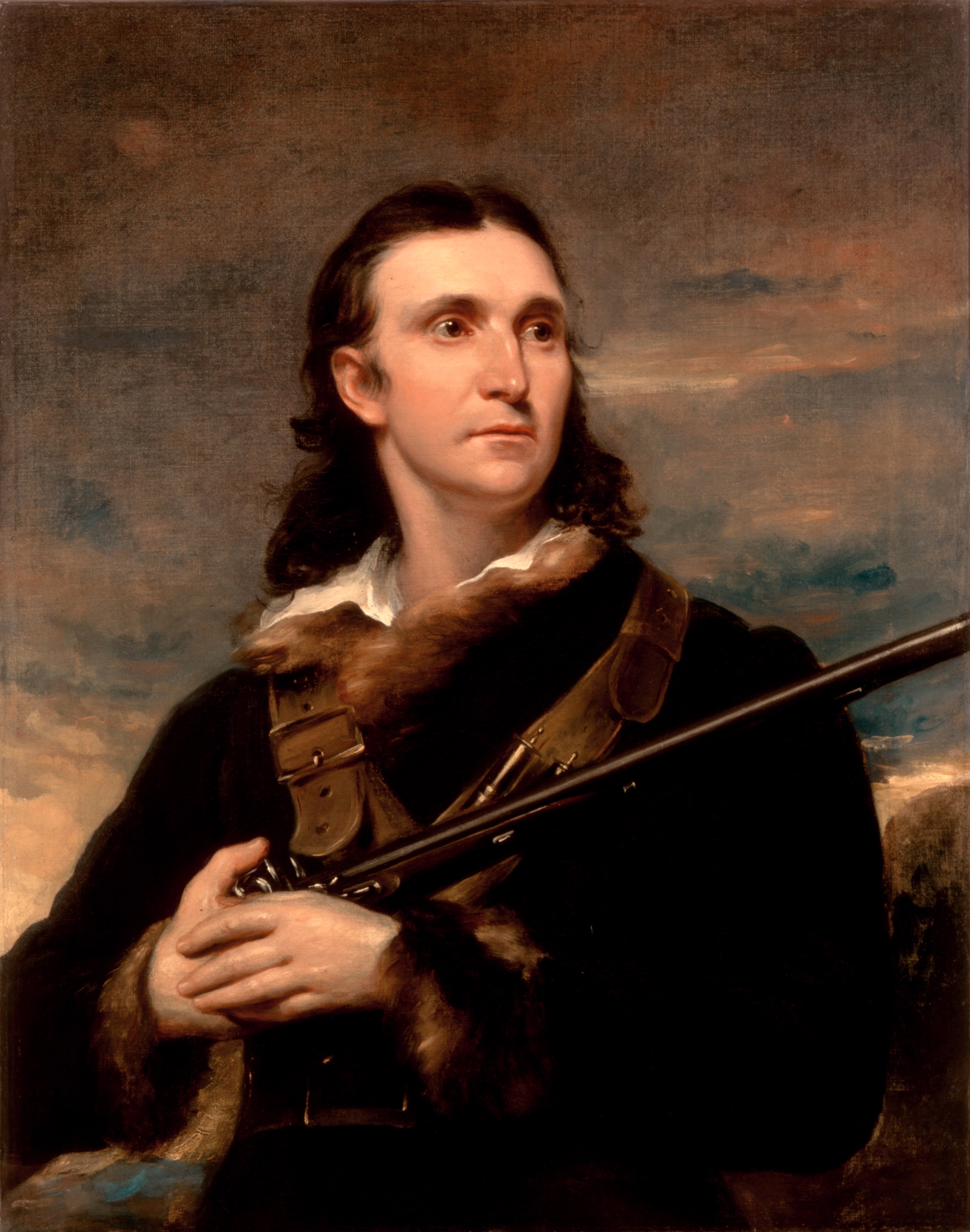
John James Audubon. Credit: Wikipedia
John James Audubon was born Jean Rabine on April 26th, 1785 in what is now Haiti. The illegitimate son of a sea captain and a chambermaid, he was formerly educated in France before being whisked to America on a false passport to avoid conscription into Napoleon's army and to look after his fathers business interests near Valley Forge, Pennsylvania. The estate bordered the Perkiomen Creek and surrounding woodland and provided a young Audubon with all the joys a young man could wish for. He went hunting and riding in the nearby woods, taxidermied birds and animals he found and shot, and vainly looked over his appearance by wearing his hair long and wearing clothes of a pioneer. He also possessed a raw talent for sketching and painting with watercolors, a trait that would cement his image as a bird artist for generations to come. It was here that he would meet his future wife, Lucy Bakewell  and together they and their growing family would travel far and wide not only for a steady source of income, but also to fulfill the drive of their patriarch to find and describe the birds of his adopted country.

It was in a general store on Louisville, Kentucky that Audubon would meet his contemporary and rival, Alexander Wilson. At many points in his life, Audubon would find it hard to support himself and his family. While his relationship with his wife would certainly have been tested during his long absences, their love for one another certainly shortened the distance and helped each other through their hard times. Despite this strong love and commitment, this didn't help with Audubon's business interests as he spent more of his time out looking for specimens than running those businesses. A few times he would even be imprisoned for outstanding debts that he'd incurred in his failed ventures.

Alexander Wilson. Credit: Wikipedia
Around the same time, Alexander Wilson was traveling around much of the eastern United States looking for people to subscribe to his magnum opus entitled American Ornithology. Born in Paisley, Scotland on July 6th, 1766 to a family of weavers, Wilson lived a mixed life before emigrating to America. While he gained the skills to become a master weaver, he dabbled in poetry and political speech before getting himself thrown in jail for blackmailing a prominent mill owner in a series of poems. While in his home country, he too was captivated by birds. He often hunted on the moors and noted the changing seasons as the various waterfowl and shorebirds migrated to and fro. After several stints in jail, he emigrated to the United States with little to his name save for his hunting gun and the clothes on his back.

Upon his arrival in America, according to birding lore, the first bird he sighted and shot when he walked to Philadelphia was a Red-headed Woodpecker (Melanerpes erythrocephalus), a bird he had never seen before. After getting settled in America, he took odd jobs as a teacher and eventually landed a job editing an encyclopedia for a wealthy Philadelphian. It was while he was getting back on his feet that he became acquainted with William Bartram, a wealthy botanist and landowner who taught him the basics of bird identification at the time and looked over Wilson's notes and pictoral descriptions of the birds he found. He famously wrote to Bartram saying to his mentor "...to mark on the drawings, with a pencil, the names of each kind, as, except three or four, I do not know them." It was around this time that he learned to engrave his own drawings using copper plates so that he could, as much as possible, be the sole producer of his massive project. As he learned and grew more confident, the scientific community of Philadelphia began to take notice and soon he won the friendship of George Ord and other scientifically minded Philadelphians. This would put Wilson at an strong advantage to Audubon's attempts to publish his Birds of America several years later due to Ord's singular and practically blind hatred for Audubon and all he stood for or represented.

Upon his arrival in Louisville, Wilson solicited Audubon for a subscription to the first two volumes of his self produced American Ornithology. However, before the other could sign, Audubon's business partner, Ferdinand Rozier, deterred him noting that Audubon didn't have the capital to pay for such a subscription and besides, his paintings were far superior to this wandering salesman. Wilson was taken aback and chagrined at this sudden refusal, but was even more stunned when Audubon showed him his portfolio for a comparison. If you've never seen the different artists next to each other, it is quite striking.
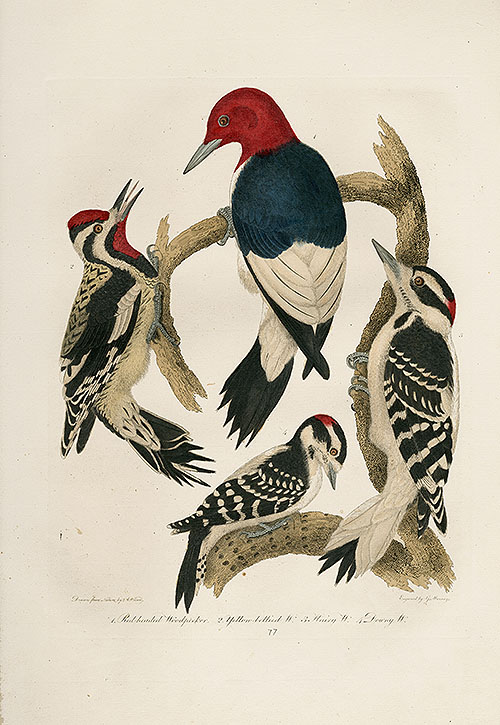
Wilson's collection of woodpeckers

Audubon's collection of woodpeckers
The difference is quite clear at first glance. Wilson focuses on presenting a single example of a species mixed in with other birds in a stiff manner, regardless if they are related to one another. The birds look lifelike enough for one to recognize them, but they look almost cartoonish in their simplicity. For a beginning birder or casual observer, these images would do just fine, but the images really feel like they're lacking artistically. Audubon picks up where Wilson lacks and surpasses him even beyond that. The plate above illustrating his collection of woodpeckers contains more species and more dynamic poses. While this doesn't necessarily enhance one's ability to identify a bird off the bat, the amount of energy and excitement you can derive from the interaction of each woodpecker species is palpable. Each seems to display their own level of aggression and aggravation towards and away from one another as the different species either shy away or launch themselves into a well posed and positioned argument. It is this animated look that Audubon specialized in, as well as providing the birds with a realistic appearance and character. Put simply, when you look at an original Audubon watercolor, they look and feel real.

Despite this apparent difference in talent however, Audubon gained no traction when it came to support for publishing his own book called The Birds of America. He was staunchly opposed by George Ord, who pointed out valid discrepancies in Audubon's work such as his copying some of the poses used by Wilson in American Ornithology and where he'd plagiarized notes from other volumes and attempted to pass it for his own observations, to outlandish and caustic remarks about Audubon's inclusion of plants in the backgrounds of his bird portraits and featuring birds in "unrealistic poses". This insurmountable opposition to potential publication forced Audubon to pursue subscribers overseas in England and France. It was here where his celebrity grew and far surpassed any that Wilson might have garnered in his life. Here he crafted himself in the image of the "American woodsman" and wore his shoulder length with a coonskin cap, buckskin jacket, and matching breeches. He looked and acted the part and through his interactions with the wealthy men of science, he made many friends. After nearly three years in Europe (a time where he deeply missed his wife and family and suffered periods of depression), he secured the help of the English engravers Robert Havell, Sr. and his son, Robert Havell, Jr. to create the plates needed. His Ornithological Biography, the accompanying text that described the species found in The Birds of America, was provided by the Scottish ornithologist William MacGillivray. When it was completed, the book was printed on elephant folio paper and a completed collection measured 2 feet wide x 3 feet tall! Audubon would later come out with a smaller version on octavo folio which was closer to the size of a modern encyclopedia.

After his success with Birds of America, Audubon with the help of his two sons, John Woodhouse Audubon and Victor Gifford Audubon, he set out to describe and paint the Viviparous Quadrapeds of North America. For those of us not versed in GRE-level language on a regular basis, he set out to document the mammals of North America, specifically the ones that walk on all fours (sorry Bigfoot) and give birth to live young. This effort was supported largely by his sons, as by this time, the elder Audubon's health was beginning to fail. He would manage to get along for few more years before dying on January 27th, 1851. His book on mammals was published posthumously the same year.

Wilson died a full 38 years beforehand on August 23rd, 1813 of dysentery. This rough end came as a result of his "nose to the grindstone" attitude and obsessive drive to find and document as many species as possible. Whereas Audubon had enjoyed fairly good health throughout his travels, Wilson suffered from poor health most of his life and this often prevented him from gathering the specimens necessary to complete his work. Fortunately, support from his Philadelphia patrons helped considerably and after he passed in 1813, Charles Lucien Bonaparte and George Ord each helped to complete the nine volume work. Despite all his work and research into discovering and describing the birds in his adoptive country, he is practically a footnote in ornithological history and greatly overshadowed by the artistic and celebrity appeal of Audubon. However, it can be argued that without Wilson's early work and meeting in Louisville, Audubon may not have been inspired to create his great work.

Regardless of modern speculation, these first contenders have all the hallmarks of a great starting contest. They match each other well in terms of their goals and interests, they achieved them with tremendous help from others, and were artists in their own right. In the next posting, I will be comparing their overall achievements and assigning points (positive and negative) to each. Who ever accumulates the most will advance to the next round.

Thursday, December 18, 2014

Babe Ruth #01: The Challengers

Despite being named for one of the most famous figures in baseball history, the purpose of the Babe Ruth of Ornithology takes very little from the world of sports. To start with, I don't pay attention to sports which means I have more time to focus on strange competitions like this one.

Also unlike a sports team which focuses on the collective achievement of a group, the goal of this competition is to focus on the achievements of a single individual and to bring to light the achievements and life histories of those ornithologists, conservationists, artists, and other bird lovers who have contributed to the study and overall appreciation of birds.

It's not hard to understand why so many people have felt compelled to learn about, explore, and experience the wonder of birds. Despite the many people I could have chosen, I have decided to keep the numbers low and focus on those who have not only inspired my own interest in birds, but most importantly provided something relevant or groundbreaking in the study or appreciation of birds. I also have focused on individuals that are relatively well known in both in the mainstream and in scientific circles alike.

The challengers were chosen from a mix of previously described candidates in my other blog posts and some new ones I only recently learned about. All of them are compelling characters in their own right and all have an equal chance of being regarded as the "Babe Ruth of Ornithology". As I list them below, I have included them in the order they will be written about and what they are most famous for. They include the following:

Match #1. John James Audubon vs. Alexander Wilson
  • The most recognized name in bird lore and creator of the Birds of America vs. The father of American ornithology before Audubon.

Match #2. Sir Peter Scott vs. Harriet Hemenway
  • The founder of the World Wildlife Fund and Wildfowl and Wetland Trust vs. The co-founder of the Massachusetts Audubon Society.

Match #3. Rachel Carson vs. Florence Merriam Bailey
  • The advocate for banning the pesticide DDT which caused declines in songbird and raptor numbers vs. The prolific writer and promoter of birding for a nonscientific audience.

Match #4. Rosalie Edge vs. Salim Ali
  • The founder of Hawk Mountain, the first raptor-only sanctuary in the United States vs. The Birdman of India who conducted the first systematic bird surveys of India.

Match #5. Kenn Kaufman vs. David Allen Sibley
  • The author of the Kaufman Field Guide series and promoter of birding and conservation vs. The author of the Sibley Guide to Birds and promoter of birding and conservation.

Match #6. Roger Tory Peterson vs. Louis Agassiz Fuertes
  • The author of one of the most popular modern bird field guides vs. The prolific bird artist who influenced future bird artists like Sibley and Peterson.

Match #7. Charles Darwin vs. John Gould
  • The father of evolutionary theory and discoverer of the Galapagos Finches vs. The father of Australian ornithology.

Match #8. Ludlow Griscom vs. Frank M. Chapman
  • The pioneer in the use of field marks to identify birds vs. The founder of the Christmas Bird Count and supporter of the early Audubon movements.
Even with sixteen candidates, it will take some time to research, document, and write about each contestant in a concise and focused manner. As such, each posting will be posted about a month apart to accommodate the time needed to research and process the information.

The contenders will have a brief biography posted before the match up that will detail their beginnings, achievements, and top three contributions to ornithology that will be pitted against their opponent. After vetting each point, I will decide who

With that being said, I'm looking forward to my first challenger's match up! With such a biological heavyweight going up against a relatively unfamiliar ornithologist, it will be interesting to see who gains the upper hand. I hope you will be able to join me to find out who gave more to the birds; John James Audubon, the author of the Birds of America vs. Alexander Wilson

See you then!

Thursday, December 11, 2014

Babe Ruth #00: Origins

For those of you who have stumbled across this blog in your travels around the internet, this blog, like many, has a singular focus. What makes this blog different is that it focuses on an unusual idea. My other blog, Nature Note: The Adventures of a Northeastern Naturalist, is devoted largely to my birding adventures, as well as some side adventures into wildlife photography, wild edibles, fishing, tracking, and more.

However, the purpose of this blog is more multifaceted. I want to reintroduce people to ornithologists, to naturalists, to people who made bird science what it is today and what is has yet to become. They include famous examples such as John James Audubon and Sir Peter Scott, and to lesser known, but equally well deserving individuals such as Alexander Wilson and Margaret Morse Nice. I'll also be introducing you to people you've probably never even heard of. With those introductions and reintroductions, I want to show you, the reader, what they became known for, what they wanted to achieve, who they were, and where they came from. I want to show you what they brought to this interesting and complicated field and how they continue to shape our world even today.

The name "Babe Ruth of Ornithology" was originally conceived in 2010 when my friend and fellow dishwasher Ed Mortimer, asked me during a lull in dish washing activity who would be considered to be "the Babe Ruth of Ornithology". I paused and said,

"Um. I don't know. Maybe Audubon?"

I hemmed and hawed for a bit longer, but couldn't really think of anyone else. After that initial poke, I put the idea on the back burner for a bit. It was only later on in the summer, that I picked up the idea again and made myself a bracket based on what ornithologists I could find on Wikipedia. From there, I tried to figure which ones had bigger and better accomplishments and from there, the basic idea was born.

Effectively what I had come up with was like March Madness with ornithologists. This brings us all the way back to 2012 when I started posting about the original 16 contenders in the B.R.O. and continued until I eventually got fed up with it. I felt like it took up too much time and effort and didn't want to bother with it anymore.

I angrily proclaimed in On the Wing #48, that I was bored of the project and declared Alexander Wilson the winner. Now nearly three years later, I've decided to give it another go. This time I will make a better effort to represent the best work of each candidate and pit them against a contender that represents an important shared aspect of ornithology. By comparing and contrasting, I hope to determine who best represents each category and who, ultimately, will triumph as the "Babe Ruth of Ornithology".

In my next posting, I'll be describing how the matches will be set up, the contenders and why they are participating, and who will be in the first match up. I'm really excited to share the match ups and participants with you all soon!

Until then, happy birding.